
How Much Does It Cost to Climb Mount Kenya? Prices and Budget Guide
Mount Kenya climbing cost depends on how many days you trek, which route you take and how much comfort you want. As a guide, a group trek to Point Lenana costs about US$700 to US$1,200 per person for three to six days. Private and luxury climbs cost more.
That price usually covers park fees, a guide, porters, a cook, food, camping or hut stays and transport from Nairobi or Nanyuki. It does not usually cover flights, travel insurance, sleeping bag hire or tips.
This guide breaks down every cost so you can plan your budget. It covers park fees, routes, extras, tips and ways to save money. Prices change each year, so treat the figures as a planning guide and ask for a current quote.
Prices checked October 2026. Park fees and package rates change, so confirm before you book.
Key facts about Mount Kenya climbing cost
Question
Answer
Typical group trek cost
About US$700 to US$1,200 per person for 3 to 6 days
Park fee (non-resident adult)
US$70 per day (2025/26 published rate)
Most popular route
Sirimon, often with a Chogoria or Naro Moru descent
Trekking summit
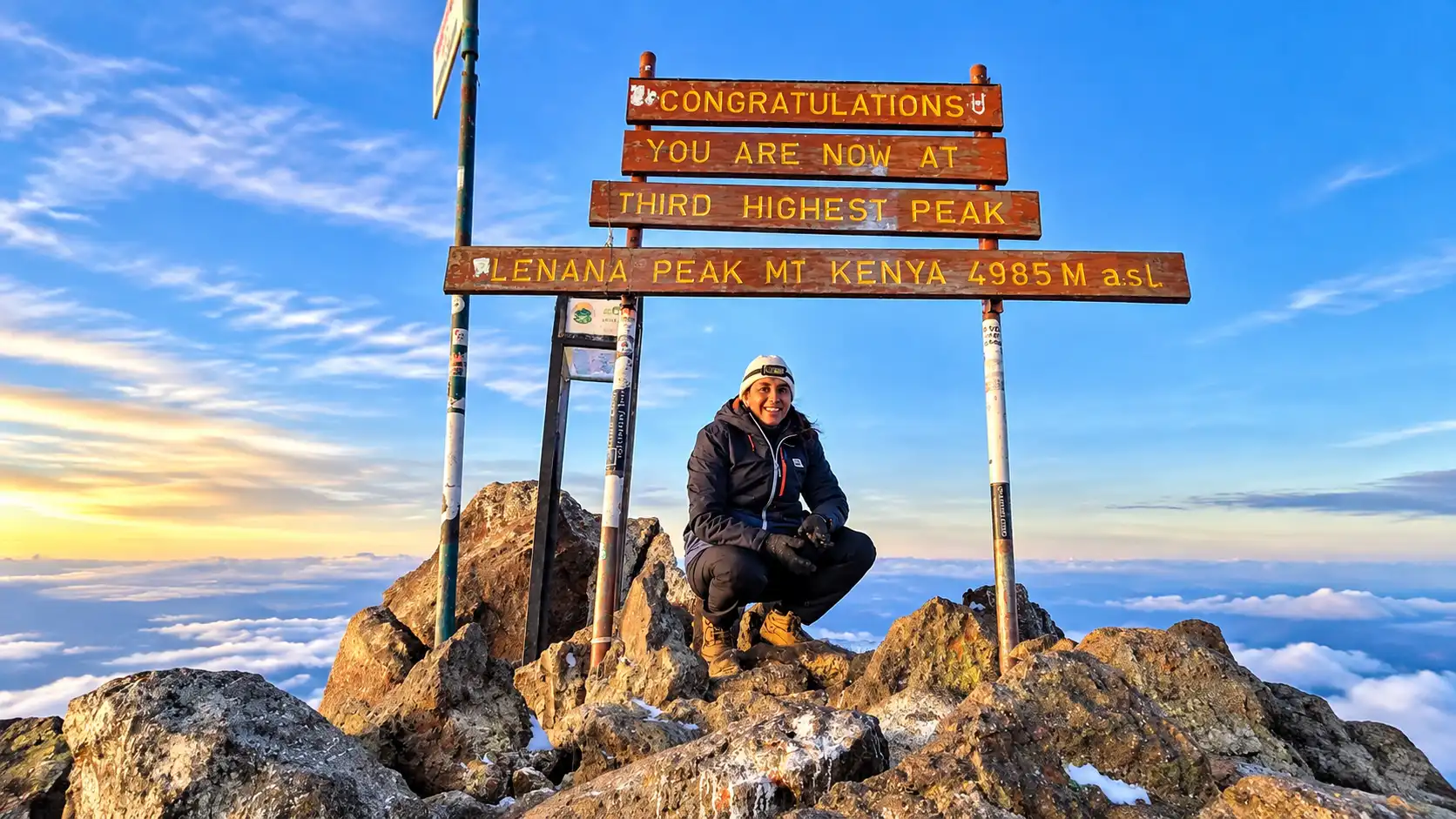
Point Lenana, 4,985 metres
Technical summit
Batian, 5,199 metres, for experienced climbers
Usual trek length
4 to 5 days
Best months
January to February and July to September
Tips to budget
About US$100 to US$150 per climber for the crew
Starting town
Nanyuki, about 150 km north of Nairobi by road
Where is Mount Kenya?
Mount Kenya is in central Kenya, about 150 kilometres north-north-east of Nairobi. It lies just south of the Equator, and the town of Nanyuki sits at its northern foot. Most climbers start from Nanyuki, Naro Moru or Chogoria.
At 5,199 metres, it is the second-highest mountain in Africa after Kilimanjaro. It is an extinct volcano, and its national park and forest were listed as a UNESCO World Heritage Site in 1997. Kenya is named after the mountain. You can read more in our guide to where Kenya is.
Olengugih Safaris is a Kenya-based safari operator. We plan treks and combine them with safaris in Laikipia, the Masai Mara and beyond.
Mount Kenya climbing cost at a glance
Trek
Days
Approximate cost per person (USD)
Best for
Short Sirimon climb to Point Lenana
3 days
650 to 800
Fit hikers short on time
Standard Sirimon or Naro Moru climb
4 days
700 to 950
Most first-time climbers
Sirimon to Chogoria traverse
5 days
800 to 1,200
Scenery and better acclimatisation
Burguret or longer traverse
6 days
950 to 1,400
Quiet trails and extra rest days
Private, small-group or luxury climb
4 to 6 days
1,500 and above
Comfort, privacy and flexibility
These are group-trek planning ranges for non-residents, including park fees, guides, porters, food and camping. Kenya residents and East African citizens pay far less in park fees. Exact prices depend on group size, season and the operator.
The quick rule: a longer trek costs more per trip, but less per day. It also gives your body more time to adjust, which raises your chances of reaching the summit.
What is included in the price of a Mount Kenya climb?
Usually included
Usually not included
Park entry fees
International and domestic flights
Licensed mountain guide
Travel and medical insurance
Porters and cook
Tips for the crew
Meals on the mountain
Sleeping bag and gear hire
Camping or hut stays on the route
Hotels before and after the climb
Treated drinking water
Drinks, snacks and personal items
Transport from Nairobi or Nanyuki to the gate
Visa or eTA fees
Climb certificate
Rescue and evacuation costs
Always ask your operator for a written list. Packages that look cheap often leave out park fees, transport or gear.
Mount Kenya National Park fees
Park fees are one of the biggest fixed costs. They are charged per person for each 24-hour period you spend in the park. The rates below are the 2025/26 daily fees published for Mount Kenya National Park.
Visitor type
Adult (per day)
Child or student (per day)
Non-resident
US$70
US$35
African citizen (non-East African)
US$30
US$15
Kenya resident
KES 1,100
KES 550
East African citizen
KES 800
KES 400
Trekking to Point Lenana is covered by the daily entry fee. Technical climbing to Batian or Nelion carries an extra permit. It is listed at about US$30 per person per day for non-residents.
Camping inside the park is charged separately. Public campsites are listed at about US$20 per adult for non-residents, and special campsites at about US$35.
Example: 4-day trek, non-resident adult
Four days in the park is roughly 4 x US$70, or about US$280 in entry fees. Add camping or hut fees if your operator does not include them. Most packages do.
Fees are paid online and are reviewed from time to time, so confirm the current rate with the Kenya Wildlife Service before you book.
Mount Kenya climbing cost by route
The route you choose changes the number of days, the transport and the price.
Route
Typical days
Approx. cost per person (USD)
What to know
4 to 5
700 to 1,000
Gentle gradient, good acclimatisation, popular ascent route
Naro Moru
3 to 4
650 to 900
Shortest and steepest. Often used for descent
Chogoria
4 to 6
800 to 1,200
Very scenic. Lakes and gorges. Longer transfers
Burguret
5 to 6
950 to 1,400
Quiet and wild. Fewer trekkers
Sirimon-Chogoria traverse
5 to 6
900 to 1,300
Best of both. Needs transport between trailheads
Point Lenana or Batian?
Most climbers aim for Point Lenana, at 4,985 metres. It is a trek, not a technical climb. Batian, at 5,199 metres, needs rock-climbing skill, ropes and a specialist guide. A technical climb costs much more, and requires extra permits and gear.
Which route is best value?
Sirimon gives the best balance of price, comfort and summit chances. The traverse costs a little more, but the scenery is hard to beat.
Extra costs to budget for
The package price is not the whole bill. Add these.
Extra cost
Approximate amount (USD)
Tips for guide, cook and porters
100 to 150 per climber for the trip
Sleeping bag, boots, poles, jacket hire
5 to 20 per item, or about 8 to 12 per day
Travel and medical insurance
50 to 300, depending on cover
Hotel in Nairobi or Nanyuki before the climb
40 to 150 per night
Nairobi to the mountain by shared transport
5 to 25
Private transfer from Nairobi
150 to 350 per vehicle
Flight Nairobi to Nanyuki
350 to 540 return
Snacks and drinks
20 to 50
Tipping guide
Tips matter on the mountain. A common guide is:
- Lead guide: US$15 to US$20 per day
- Assistant guide: US$10 to US$15 per day
- Porters and cook: US$7 to US$10 per day each
Tips are usually paid at the end of the trek, divided by the group. Ask your operator for current guidance.
Insurance
Travel insurance should cover trekking up to 5,000 metres and emergency evacuation. Kenya also requires visitors to hold travel health insurance. Check the latest rules before you fly.
Budget, mid-range and luxury Mount Kenya climbs
Style
Approx. total per person (USD)
What you get
Budget
650 to 900
Shared group, camping or basic huts, simple meals, hired gear
Mid-range
900 to 1,500
Small group, better food, comfortable camps, experienced guides
Luxury
1,500 to 3,000+
Private guide, extra acclimatisation days top gear and transfers
Budget
Join a group, camp and hire your gear. This is the best way to climb on a tight budget.
Mid-range
Most climbers choose this level. You get a smaller group, better meals and more support on the trail.
Luxury
Choose this if you want privacy, comfort and extra days to adjust to altitude. A private team also moves at your pace.
Whatever you pick, never trade safety for savings. Choose a licensed operator, proper guides and enough days to adjust to the altitude.
What affects Mount Kenya climbing cost?
- Number of days. Each extra day adds park fees, food and crew costs.
- Group size. A bigger group shares guide, cook and transport costs. Solo climbers pay the most per person.
- Route. Chogoria and Burguret need longer transfers than Sirimon.
- Season. Peak months cost more and book out sooner.
- Accommodation. Camping is cheapest. Huts and lodges cost more.
- Crew size. More porters mean lighter loads for you and a higher price.
- Residency. Kenya residents and East African citizens pay lower park fees.
- Gear. Hiring is cheaper than buying if you will climb once.
- Transport. Shared matatu rides cost far less than private transfers or flights.
How to save money on a Mount Kenya climb
- Join a group departure to split costs.
- Climb in the shoulder months, when rates drop.
- Hire gear instead of buying it.
- Use shared transport to the trailhead.
- Camp instead of staying in huts or lodges.
- Book early for better choice and rates.
- Compare written quotes, not just headline prices.
Where not to save:
- Skip nothing on acclimatisation days.
- Do not drop the guide or porters.
- Do not pick an unlicensed operator.
- Do not go without insurance that covers altitude and evacuation.
A cheap price is no bargain if it ends your climb early.
Best time to climb and when to book
The two main climbing windows are the dry seasons.
Months
Conditions
Cost impact
January to February
Dry and clear. Good summit weather
Moderate
July to September
Dry and cold. Peak season
Highest
March
Warming up, rain may begin
Moderate
April to May
Long rains. Wet, slippery trails
Lower
October to December
Short rains. Fewer climbers
Lower to moderate
Book three to six months ahead for peak months. Last-minute spaces do exist, but you may pay more or lose your preferred dates.
Frequently asked questions
How much does it cost to climb Mount Kenya?
A group trek usually costs about US$700 to US$1,200 per person for three to six days. Private and luxury climbs cost more. The price normally includes park fees, guides, porters, food and camping.
What is the cheapest way to climb Mount Kenya?
Join a group trek, camp, hire your gear and use shared transport to the trailhead. Short three or four day climbs cost least, but give you less time to adjust to the altitude.
How much are Mount Kenya National Park fees?
The published daily fee is US$70 for a non-resident adult and US$35 for a child. Kenya residents pay KES 1,100 and East African citizens KES 800 per adult per day. Confirm current rates with the Kenya Wildlife Service.
Do I need a guide to climb Mount Kenya?
Yes, in practice. Guides are required on the mountain and help with route-finding, safety and weather. Most packages include a guide, cook and porters.
How much should I tip the guide and porters?
Budget about US$100 to US$150 per climber for the whole crew on a typical trek. Daily tips run from about US$7 for a porter to US$20 for a lead guide, depending on role.
Can I climb Mount Kenya on a budget?
Yes. Choose a group departure, camp, hire gear and travel in the shoulder months.
Is Mount Kenya cheaper than Kilimanjaro?
Mount Kenya is generally cheaper and shorter, with lower park fees per day and fewer days. Prices depend on the operator and route.
How many days do you need?
Four to five days is ideal for most people. Three days is possible if you are fit, but leaves little time to adjust to the altitude.
Do I need to hire gear?
Only if you do not own it. Sleeping bags, boots, poles and jackets can be hired at a small daily cost.
What is included in a Mount Kenya package?
Usually park fees, guide, porters, cook, meals, camping or huts and transport from Nairobi or Nanyuki. Flights, insurance, tips and gear hire are normally extra.
Is travel insurance needed?
Yes. Choose a policy that covers trekking to about 5,000 metres and emergency evacuation.
How fit do I need to be?
You should be able to hike for five to eight hours a day. Altitude is the main challenge, so give yourself time to adjust.
Plan your Mount Kenya climb with Olengugih Safaris
Tell us your dates, fitness level and budget. We will suggest the right route and trek length, explain what is included and give you a clear quote with no surprises. You can also add a safari in Laikipia or the Masai Mara before or after your climb.
Contact Olengugih Safaris to price your Mount Kenya trek.
Sources and further reading
- Mount Kenya, Wikipedia
- Mount Kenya, Encyclopaedia Britannica
- Mount Kenya National Park entry fees 2025/26
- Kenya Wildlife Service, official park fee schedule (confirm the latest rates on its website)