Your Route Map
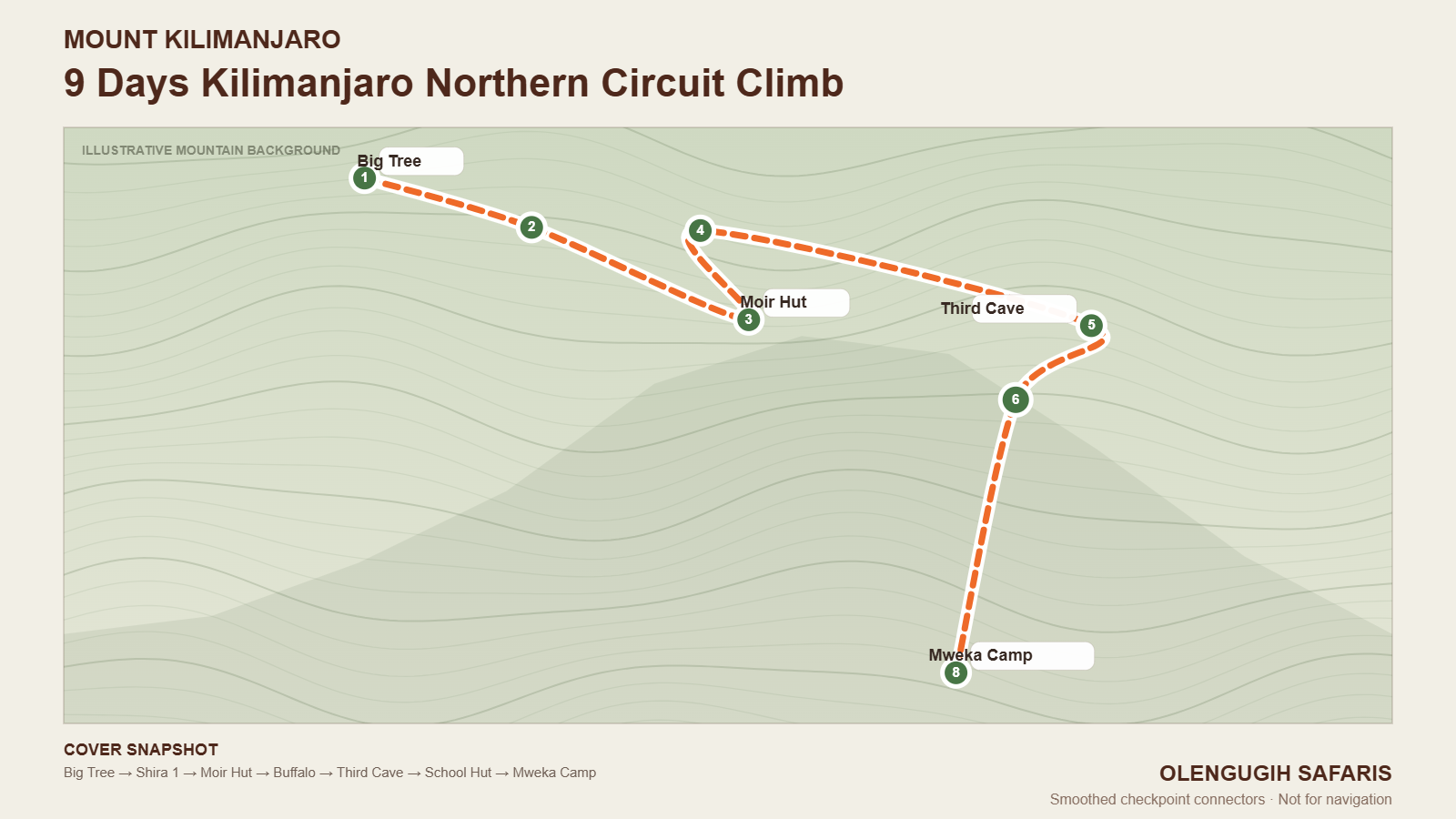
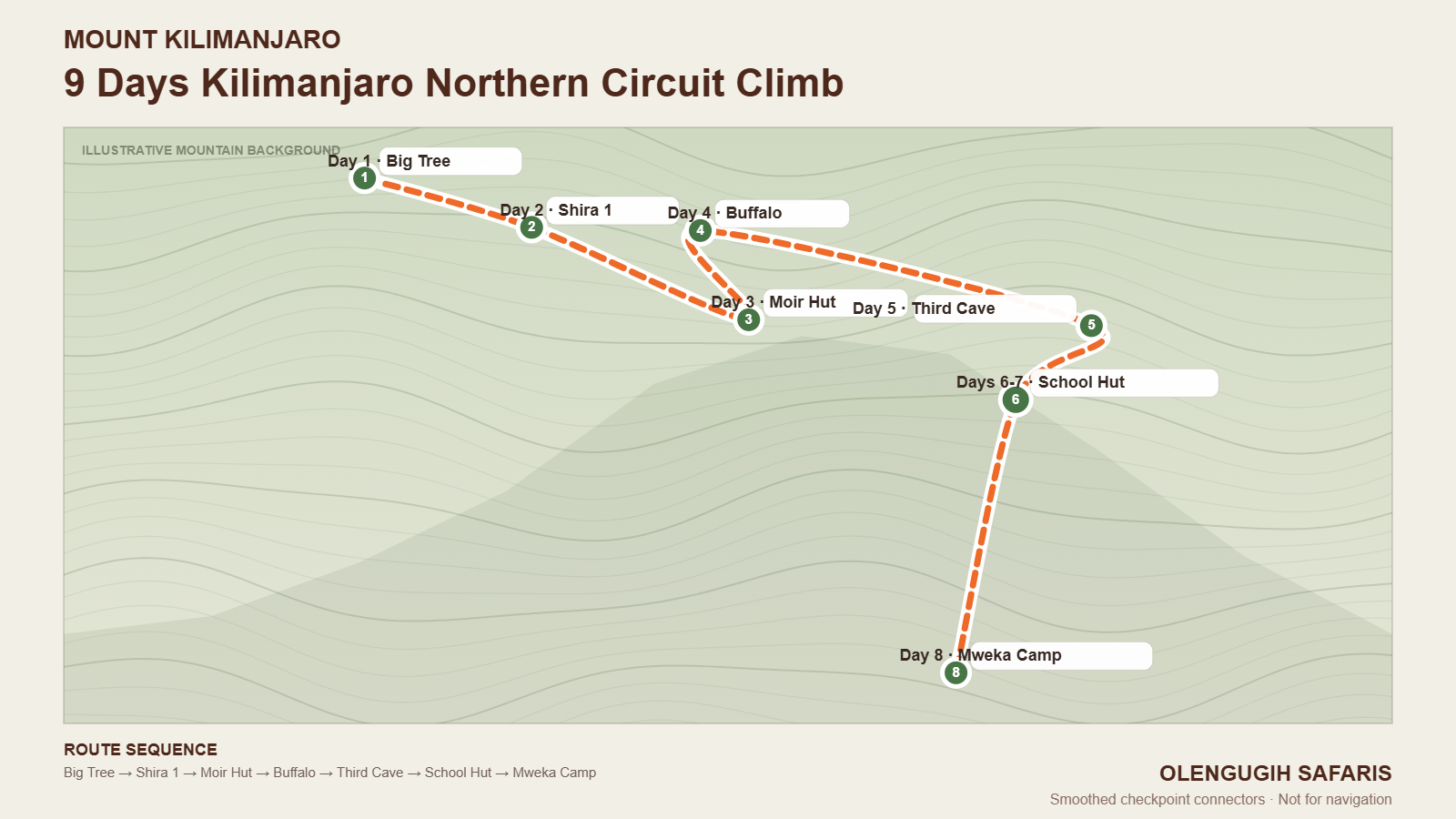
Explore the main stages of the Northern Circuit Route. The image is a planning illustration, not a navigation map; follow your licensed mountain guide on the trail.
Expedition Overview
9 Days Kilimanjaro Northern Circuit Climb
Experience Mount Kilimanjaro’s Northern Circuit on a nine-day trekking itinerary that begins in the western rainforest, crosses the open Shira Plateau and follows the quieter northern side of Africa’s highest mountain. This route is designed for hikers who want to spend more days among changing mountain landscapes before an attempt on Uhuru Peak at 5,895 metres. The journey finishes with a long descent through the southern mountain zones to Mweka Gate.
The itinerary follows the Lemosho-side access from Londorossi, climbs through Big Tree and Shira 1 camps, then reaches Moir Hut before contouring around the northern slopes toward Buffalo Camp and Third Cave. The final high camp is School Hut. From there, the plan includes an additional day at the same camp before a demanding overnight summit ascent. After the summit attempt, the route drops to Mweka Camp and exits the park the following morning.
What makes this nine-day Northern Circuit itinerary different?
Instead of travelling only along the busy southern approaches, the Northern Circuit offers a changing perspective on Kilimanjaro. Early stages introduce forest, heath and the broad volcanic plateau. In the middle of the itinerary, the track enters more exposed terrain with views across the northern plains. The final stages are defined by cold, rocky ground, thin air and a substantial summit-to-camp descent. A longer trip allows additional time to experience these environments, but nine days do not guarantee acclimatization or summit success.
Who is this climb suitable for?
This is a challenging high-altitude trek for walkers with good endurance and experience on long, uneven trails. Previous technical climbing experience is not normally required for the standard trekking route, but physical fitness alone cannot prevent altitude illness. Climbers should be comfortable with consecutive days of walking, basic mountain camping and a potentially 12 to 16 hour summit-and-descent day.
Important note about the School Hut acclimatization day
The referenced nine-day schedule includes two consecutive nights at School Hut, around 4,750 metres. An extra night at this high elevation is not automatically safer; the sleeping-altitude profile must be evaluated by the operating mountain guide and, where appropriate, a qualified medical professional. Olengugih Safaris will confirm whether this exact camp plan is appropriate or whether the route needs adjustment before taking a booking. Climbers must report symptoms promptly and follow the guide’s decision on rest, descent or stopping the ascent.
Mountain camps, meals and arrangements
The plan accounts for eight nights in mountain camps: Big Tree, Shira 1, Moir Hut, Buffalo, Third Cave, two nights at School Hut and Mweka. The source itinerary lists breakfast, lunch and dinner daily, with guiding and camping support described during the trek. However, it does not give a reliable mountain-specific cost breakdown. Park fees, rescue cover, guide-to-guest ratios, equipment hire, airport logistics and pre- or post-climb hotel nights must be confirmed separately in the Olengugih Safaris written quotation. No published starting price is assumed.
Explore the Kilimanjaro routes and prepare for your ascent
Compare the wider Northern Circuit route guide, learn about Mount Kilimanjaro, read our mountain climbing preparation guide and consult the official Kilimanjaro National Park visitor guide before sending an enquiry. Weather, trail access, camp allocations and individual health can change the operating plan. All mountain expeditions are customized and privately arranged, with no scheduled group departures.
Frequently asked questions
Does the nine-day itinerary include airport arrival and departure days?
No. The referenced nine-day count starts at Londorossi Gate and ends at Mweka Gate. Flight arrival, a hotel night before the climb and onward travel after the descent require separate confirmation.
Where does the Northern Circuit trek begin and end?
The listed trail begins at Londorossi Gate in western Kilimanjaro and ends at Mweka Gate after the summit attempt and descent.
Are all nine days spent trekking?
The programme lists nine days on the mountain, but Day 7 is allocated primarily to rest and preparation at School Hut. It still involves a high-altitude overnight rather than a lower-elevation recovery day.
Is reaching Uhuru Peak guaranteed?
No. Summit plans depend on weather, mountain regulations and each climber’s condition. Any signs of serious altitude illness must take precedence over the summit objective.
Climbing Itinerary
Londorossi Gate to Big Tree Camp
The Northern Circuit adventure begins at the western entrance to Kilimanjaro, where the mountain team completes park registration and checks that everyone is ready to begin walking. From the Londorossi area, the route enters a humid forest environment. Tall trees, mossy branches and ferns provide shade over a winding trail, while the sounds of birds and the possibility of seeing forest wildlife make this first stage especially atmospheric.
The day is a useful introduction to the mountain’s slower walking rhythm. As the track gradually climbs from roughly 2,100 to 2,750 metres, guides can assess everyone’s pace and encourage regular pauses for water and rest. Conditions may be wet or muddy even if the lower towns are sunny, so rain protection and reliable footwear should be readily accessible. Reach Big Tree Camp in the afternoon, meet the camp routine and organize warm clothing for the night. The first evening is devoted to dinner, hydration and preparing for tomorrow’s transition onto the moorland.
Big Tree Camp to Shira 1 Camp
After breakfast, leave the lower forest behind as the trail moves toward more open heath and moorland. Trees become fewer, vegetation grows lower and the scale of Kilimanjaro begins to reveal itself. On clear stretches, the mountain’s upper volcanic mass comes into view while hardy plants spread across the rolling slopes. This is a substantial elevation-gain day, so maintaining an even, unhurried pace is more useful than trying to reach camp quickly.
The route approaches the broad Shira Plateau, where the open landscape feels very different from the enclosed forest of Day 1. The intended overnight stop is Shira 1 Camp at about 3,500 metres. Once camp is reached, allow enough time to recover from the ascent, eat well and monitor how you are adjusting to the thinner air. Nights can be notably colder and windier than at Big Tree. The guide should review how everyone feels before continuing to the higher Moir area the following day.
Shira 1 Camp to Moir Hut
Today the mountain becomes quieter and more rugged as the itinerary leaves Shira 1 and heads toward Moir Hut. The route crosses open volcanic ground where vegetation is sparse, the air is dry and exposed sections may be affected by wind or bright sun. Distances can feel harder than expected because the trail rises from approximately 3,500 to 4,200 metres. Take small steps on uneven rock and listen to the guide’s instructions about pace and rest breaks.
As the day develops, the surroundings change from broad plateau scenery to a more isolated landscape beneath Kilimanjaro’s upper cone. The Moir area is valued for its sense of remoteness and for views of the massif when cloud permits. At camp, focus on a warm meal, adequate fluid intake and an early night. Headaches, nausea, dizziness or unusual fatigue should be reported promptly rather than dismissed as normal tiredness. The aim is to arrive well enough to tackle the undulating northern traverse, not simply to reach a particular altitude.
Moir Hut to Buffalo Camp
From the Moir area, the Northern Circuit bends around the mountain’s northern side, where the trail crosses exposed volcanic ridges and open alpine-desert terrain. The landscape is expansive, with far-reaching views toward the plains in clear weather and fewer of the familiar landmarks found on more travelled southern routes. The route is not flat: there are climbs and descents across uneven ground, even though the overnight altitude changes only modestly.
The listed camping point is Buffalo Camp, around 4,120 metres. As you contour across this remote slope, expect wind exposure and terrain that may require deliberate footing. A steady pace leaves energy for the days still ahead and gives guides more opportunity to assess responses to altitude. Settle into the camp as temperatures fall, protect yourself from the cold and eat even if high altitude has reduced your appetite. The following stage heads farther across the northern flank toward Third Cave.
Buffalo Camp to Third Cave
The fifth stage continues the traverse across Kilimanjaro’s northern flanks, passing through dry, high-elevation terrain marked by volcanic dust, scattered stones and broad views toward Kibo. The trail generally trends toward a lower overnight elevation, but that does not remove the physical demands of several hours on open ground. Conditions can feel hot under strong sun and cold in the wind, sometimes within the same walking day.
Third Cave is the planned overnight area, at approximately 3,870 metres. Reaching a somewhat lower camp after previous higher nights may feel more comfortable for some trekkers, but each person responds differently to altitude. Use the afternoon for food, water, equipment checks and discussion of the much steeper climb to School Hut ahead. Check footwear, spare batteries, gloves and insulation while there is daylight. The mountain guide should pay attention to any symptoms and decide whether the group is fit to move higher the next morning.
Third Cave to School Hut
Today’s route climbs from the Third Cave area toward School Hut, the high camp identified in the reference itinerary. The terrain becomes increasingly stony and barren, with stretches of volcanic rock beneath the Kibo massif. Although the expected walking time is shorter than on some earlier days, the ascent to about 4,750 metres is a serious gain in sleeping altitude. Progress should be measured, with attention to breathing, fatigue and how well the body is coping.
After reaching the camp, the priority is recovery rather than sightseeing. Eat, drink and keep warm as the temperature drops. Check summit layers, headlamp, batteries, snacks, water containers and the clothing you will need when walking in darkness. The source itinerary schedules another night at this same high camp before summit day. That decision requires specific operational and medical review; an extra night at 4,750 metres must not be treated as a universally safe acclimatization method. Any concerning symptoms require assessment and potentially descent.
School Hut High-Altitude Rest and Assessment Day
The reference schedule allocates Day 7 to rest, observation and preparation at School Hut rather than a full trekking stage. Climbers would remain at roughly 4,750 metres while the guide reviews their condition and readiness for a summit attempt. Meals, hydration, sleep and protection from the cold are important, but none of these measures guarantees that the body will adapt to this altitude.
Operational safety review is essential: two consecutive nights at School Hut can be inappropriate for some climbers. Olengugih Safaris must have the proposed sleeping-altitude profile assessed by the actual mountain operator before offering this as an approved schedule. The team should discuss symptoms individually and have a practical descent and emergency plan. If weather or health makes staying at high camp unwise, the programme should change. If the guide authorizes the continued ascent, the afternoon is reserved for checking summit clothing and headlamps and receiving a clear briefing on the overnight departure, turnaround criteria and expected length of the next day.
School Hut to Uhuru Peak, Then Mweka Camp
The summit attempt begins during the night, subject to the guide’s assessment of conditions and each climber’s health. From the School Hut area the ascent heads onto the higher slopes of Kibo. Progress is usually slow over loose, cold and exposed ground, with headlamps illuminating only a short section of trail at a time. The most demanding work comes at extreme altitude, and the pace may need to change frequently. The goal is Uhuru Peak, at 5,895 metres, but reaching the summit is never more important than safe decisions about weather, exhaustion or altitude illness.
If conditions allow a summit visit, pause only as long as the guide considers safe before starting the major descent. The day is not finished when you turn downhill: reaching Mweka Camp requires several more hours, substantial loss of elevation and sustained attention on tired legs. Expect the landscape to change again as you leave the highest volcanic zone. The referenced schedule estimates around 12 to 16 hours for the complete ascent and descent, making this the expedition’s most strenuous day. A warm meal and rest at Mweka Camp follow arrival.
Mweka Camp to Mweka Gate and Transfer Out
The final morning descends from Mweka Camp through progressively greener vegetation toward the park exit. As the trail drops from about 3,100 to 1,640 metres, the air becomes warmer and the forest returns. This section is generally less strenuous than the summit day, though tired knees, damp steps and slippery roots still call for care. There is time to appreciate the contrast between the cold upper mountain and the lower rainforest crossed at the end of the trek.
At Mweka Gate, the team completes park sign-out and other official procedures. Summit documentation, where applicable, follows current park rules and the result of the climb. The referenced programme then provides a vehicle transfer back toward accommodation in the Moshi area, but it does not establish whether that hotel night, onward airport transfers or additional meals are included in Olengugih’s selling price. Those details must be settled in the written quotation. The nine-day mountain itinerary ends after the descent and transfer arrangements.
Inclusions
- Mountain guide support during the trek, with guide qualifications and ratio to be confirmed
- Porter-supported mountain camping at the eight listed overnight stops, subject to operating arrangements
- Breakfast, lunch and dinner on trekking days as shown in the reference schedule, subject to first- and last-day timing
- Drinking water during the trek, with quantity and treatment arrangements to be confirmed
- Private airport collection and transfers described by the reference operator, with exact transfer coverage to be confirmed
- Applicable VAT or taxes only where stated in the final Olengugih Safaris quotation
Exclusions
- International flights to and from Tanzania
- Tanzania entry visa and applicable immigration charges
- Personal travel and medical insurance, including evacuation cover
- Tips and gratuities for the mountain guide, porters and support staff
- Personal purchases, toiletries and other personal expenses
- Beverages and drinks at hotels or lodges beyond the agreed meal and water service
- Optional activities or services not expressly itemized in the final quotation
Climbing Experience Reviews
Read feedback shared about this climbing trip or leave your own experience. Reviews are checked by our team before publication. Submitting a review does not guarantee it will be published.
No published reviews for this climbing package yet. Share your experience using the form below.
Write a Review
Tell other climbers how your trip went. Your email stays private. Reviews must be about a genuine experience, without links or promotions.