


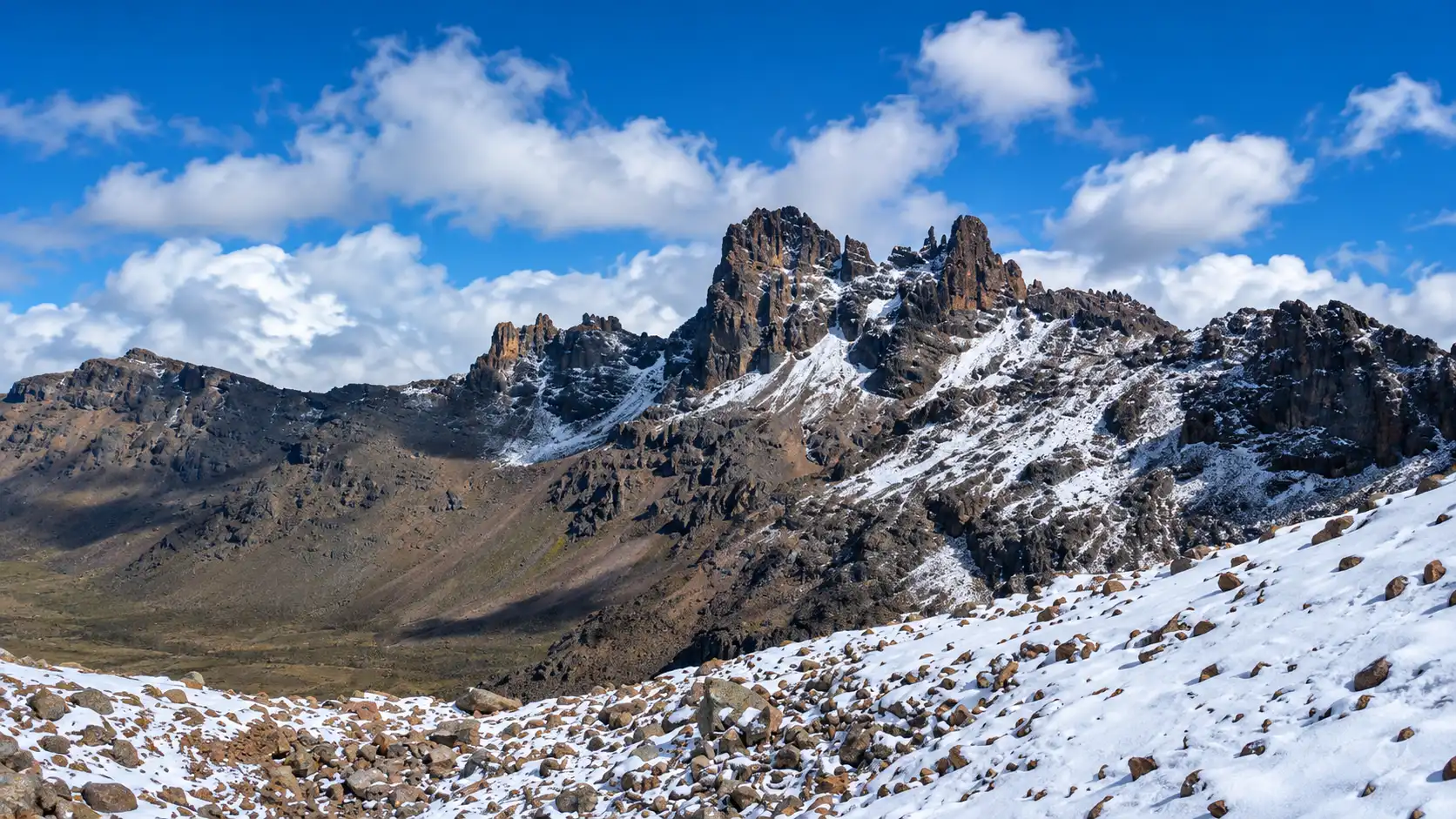
Mt Kenya Peaks
Mt Kenya has three main peaks: Batian (5,199 m), Nelion (5,188 m) and Point Lenana (4,985 m). Batian is the highest. Point Lenana is the only one trekkers can reach without technical climbing.
Last updated: 17 November 2026
Mt Kenya peaks at a glance
- Highest peak: Batian, 5,199 m. Technical rock climbing only.
- Second highest: Nelion, 5,188 m. Technical rock climbing only.
- Trekking peak: Point Lenana, 4,985 m. No ropes needed.
- Gap between the twin peaks: about 250 m, across the Gates of Mist.
- Location: central Kenya, just south of the equator.
- Days to reach Lenana: 4 to 5 for most climbers.
- Best months: January to February, and July to September.
- Origin: an extinct volcano. The peaks are the old volcanic plug.
The main peaks of Mt Kenya and their heights
Heights vary by a few metres between surveys. Use these as a guide.
Peak | Height | How you reach it | Named after |
|---|---|---|---|
Batian | 5,199 m | Technical rock climb | Maasai chief Mbatian |
Nelion | 5,188 m | Technical rock climb | Mbatian's brother, Nelieng |
Point Lenana | 4,985 m | Non-technical trek | Mbatian's son Lenana |
Point Pigott | 4,957 m | Scramble and rock climbing | An early colonial administrator |
Point Thomson | 4,955 m | Technical climbing | A Royal Geographical Society photographer |
Point Dutton | 4,885 m | Technical climbing | An early settler |
Terere | 4,714 m | Rock climbing | A Maasai headman |
Sendeyo | 4,704 m | Rock climbing | Mbatian's eldest son |
The central peaks are volcanic plugs. They survived the glaciers that wore away the rest of the volcano.
Each Mt Kenya peak explained
Batian: the highest peak (5,199 m)
Batian is the highest point in Kenya. It was first climbed in 1899 by Halford Mackinder with guides Cesar Ollier and Joseph Brocherel. They went up Nelion and crossed the Gates of Mist. Today, only experienced rock climbers attempt it. Very few people summit Batian each year.
Nelion: the twin peak (5,188 m)
Nelion is just 11 m lower than Batian. The two peaks stand about 250 m apart. A gap called the Gates of Mist separates them. Nelion is a popular technical climb. Climbers often combine it with Batian.
Point Lenana: the trekking peak (4,985 m)
Point Lenana is the third highest peak. It needs no ropes or rock-climbing skills. Most visitors to the national park climb this peak. You walk up in the dark and reach the summit at sunrise. You see Batian and Nelion rising beside you.
Point Pigott and Point Thomson
Point Pigott (4,957 m) and Point Thomson (4,955 m) sit close to the main summits. They are popular with rock climbers. Pigott is named after an acting administrator of the Imperial British East Africa Company.
Terere and Sendeyo: the twin outliers
Terere (4,714 m) and Sendeyo (4,704 m) are craggy peaks north of the main plug. They stand apart from the central group. Sendeyo is named after Mbatian's eldest son.
Why the names matter
The three highest peaks honour a Maasai family of medicine men. Local people regard the mountain as sacred. Respect for that heritage is part of any climb.
Which Mt Kenya peak should you climb?
Most visitors should choose Point Lenana. It gives you the sunrise view and the Mt Kenya summit experience without technical skills.
Your goal | Best peak | Typical time |
|---|---|---|
First high-altitude trek | Point Lenana | 4 to 5 days |
Scenic route and lakes | 5 to 6 days | |
Fast climb for fit trekkers | 3 to 4 days | |
Rock-climbing challenge | Nelion or Batian | 6 days or more, with a specialist guide |
Routes to Point Lenana
- Sirimon: a gradual climb on the drier northern side.
- Naro Moru: the shortest and steepest route.
- Chogoria: the most scenic route, past Lake Michaelson and deep gorges.
- Traverse: go up one route and come down another for the best views.
Mt Kenya sits close to the equator and has two climbing seasons. January to February and July to September are the driest months. Allow 4 to 5 days for most treks. Altitude sickness is possible above 3,500 m, so ascend slowly.
Technical peaks need experience
Batian and Nelion need rock-climbing skills, ropes and a qualified guide. Do not attempt them as a first mountain. Bring your own technical gear or arrange rental in advance.
Frequently asked questions
What are the peaks of Mt Kenya?
The main peaks are Batian (5,199 m), Nelion (5,188 m) and Point Lenana (4,985 m). Other peaks include Point Pigott, Point Thomson, Terere and Sendeyo.
What is the highest peak of Mt Kenya?
Batian is the highest peak at 5,199 m. It is also the highest point in Kenya.
Which Mt Kenya peak can I climb without technical skills?
Point Lenana, at 4,985 m. It is a trek, not a technical climb. Most visitors summit this peak.
How high is Point Lenana?
Point Lenana is 4,985 m above sea level. That is about 214 m lower than Batian.
Is Mt Kenya the second highest mountain in Africa?
Yes. Mt Kenya is the second highest mountain in Africa, after Kilimanjaro in Tanzania.
How far apart are Batian and Nelion?
The two peaks are about 250 m apart. A gap called the Gates of Mist separates them.
Who named the peaks of Mt Kenya?
The three highest peaks carry Maasai names. Other peaks honour explorers, administrators and early settlers.
Who first climbed Batian?
Halford Mackinder, Cesar Ollier and Joseph Brocherel reached Batian in 1899. They climbed via Nelion and the Gates of Mist.
How long does it take to climb Point Lenana?
Most climbers take 4 to 5 days. Fit climbers can do it in 3 to 4 days on Naro Moru.
Can Olengugih Safaris arrange a trek to Point Lenana?
Yes. We guide Point Lenana treks of 4, 5 and 6 days. We can add a safari before or after.
Trek to Point Lenana with Olengugih Safaris
We guide Mt Kenya treks of 4, 5 and 6 days. Tell us your dates and fitness level. We will recommend the best route to Point Lenana. Our packages include rescue insurance. You can add a Masai Mara or Amboseli safari after your climb.
Sources
- Peakvisor and Wikipedia, Mount Kenya: peak heights and the Gates of Mist
- Wikipedia, List of names on Mount Kenya: origin of peak names
- Armchair Mountaineer, Mount Kenya: peak list and first ascent of Batian
- Kenya Wildlife Service: Mount Kenya National Park information