On December 13, the Masai Mara lost one of its most iconic cheetahs. Nora the Cheetah, killed in Mara, marked the end of a 13.5-year life following a fatal encounter with a leopard known as Bella Two. Her death closed a long chapter defined by endurance, repeated loss, and relentless survival pressure.
Nora was more than a familiar individual within long-term monitoring records. Her life reflected the daily reality female cheetahs face in predator-dense landscapes. Survival required constant vigilance, careful movement, and precise decision-making across open plains and risky cover. Longevity came at a measurable cost, paid through frequent reproduction and unavoidable conflict.
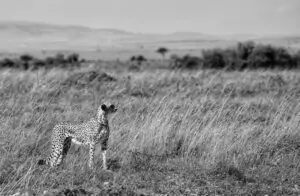
The photo above is of Nora in the Mara Plains (Photo courtesy of Ralf Tobias Photography). You can also experience such a beautiful sighting on a 6-Day Kenya Safari with the Masai Mara as the ultimate safari destination.
Early Independence and Survival Strategy
Nora was born in April 2012 to a female cheetah named Narasha, alongside her brother M23 Nur. Her early months followed a typical cheetah upbringing across the Maasai Mara plains. That stability ended early.
In December 2013, Narasha left the cubs, forcing them to achieve early independence. By February 2014, Nora had separated from her brother and had begun life alone at just 21 months old. For female cheetahs, early independence significantly increases their mortality risk.
Without coalition support, survival depended on efficient hunting and constant evasion of predators. Lions, leopards, and hyenas posed daily threats. Nora adapted quickly, refining movement patterns and hunting timing to reduce encounters with dominant predators.
Reproduction and Repeated Cub Loss
From October 2014 onward, Nora was recorded pregnant more than fifteen times. She gave birth to over eleven litters sired by different males. This reproductive output remains exceptional among wild female cheetahs.
Cub survival rates remained low. Most cubs were lost within the first two months, primarily due to predation. These losses reflect the vulnerability of cheetah cubs in ecosystems dominated by stronger carnivores.
Frequent pregnancies placed sustained strain on Nora’s body. Cub rearing increased exposure to predators while reducing mobility. Food requirements rose during periods when speed and endurance were critical.
Despite these pressures, reproduction continued across multiple seasons. Persistence, rather than favourable conditions, defined her reproductive history.
Predator Overlap and Physical Decline
The Maasai Mara supports multiple apex predators within overlapping habitats. Open grasslands favour cheetah hunting strategies, while wooded riverlines favour leopards. This spatial overlap creates unavoidable conflict.
Cheetahs lack the strength to defend territory or fight against leopards. Avoidance remains their primary survival strategy. Nora navigated these risks for over a decade through experience and spatial awareness.
With age, reaction speed and recovery declined. These changes reduced escape margins during encounters. Her fatal conflict reflects the vulnerability of ageing cheetahs in predator-dense systems.
Ecological Significance of a Long Life
Nora survived well beyond the average life expectancy of a wild cheetah. This longevity enabled the observation of ageing, reproduction, and survival trade-offs that are rarely recorded in female cheetahs. Her life provided long-term insight into biological limits.
Her movements, breeding history, and cub losses help explain population constraints in the Masai Mara. These observations show why cheetah numbers remain limited despite suitable habitat.
Nora’s life demonstrates how female cheetah survival depends on endurance, adaptation, and tolerance of repeated biological loss.
Witness these realities firsthand by booking a Masai Mara safari with us and experience the ecosystem that shaped her life.