What Experienced Safari Guides Know About the Wildebeest Migration
The Wildebeest Migration Is a Living System, Not an Event
Experienced safari guides understand something many travel brochures do not: the wildebeest migration is not an event you arrive for, it is a living system you enter. It has no start whistle, no finale, and no guarantees. The migration responds to rainfall, grass quality, soil minerals, predator pressure, and ancient instinct. These forces shift constantly, sometimes daily. Guides who work the migration year after year plan with humility, knowing that animals—not itineraries—are in control. When agencies sell the migration as a scheduled spectacle, they set guests up to expect certainty in a landscape defined by change. Guides know that the magic lies in understanding the system, not trying to dominate it.
Movement Patterns Matter More Than River Crossings
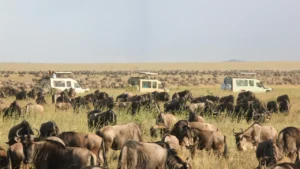
River crossings dominate marketing because they are dramatic, visual, and easy to sell. Guides know they are only a small part of the story. The migration is primarily about movement patterns across vast grasslands, not about water. Wildebeest move because the grass ahead is better than the grass behind. Rivers simply become obstacles when the best grazing lies beyond them. In many seasons, herds spend weeks far from rivers, spreading across plains, feeding, resting, and slowly advancing. Some of the most powerful migration experiences happen during these quiet phases, when tens of thousands of animals fill the horizon without ever approaching a crossing point.
Grass and Rain Are the True Navigation Tools
Ask an experienced guide what they watch first, and they will say rain, not rivers. Fresh rainfall triggers new grass growth, and new grass dictates movement. Certain soil types produce sweeter, more mineral-rich grass that attracts herds faster than others. Guides track storm patterns, cloud buildup, and even rainfall hundreds of kilometers away. This is why herds can suddenly change direction or stall for weeks. Travelers who understand this stop asking, “Will we see a crossing?” and start asking better questions, like, “Where is the grass improving?” That shift in mindset dramatically improves safari outcomes.
Dates Without a Regional Strategy Mean Very Little
“July to October is migration season” is a half-truth that guides should be cautious about. The Masai Mara alone contains multiple regions that respond differently to movement. Northern areas near rivers may be ideal during active crossings, while central and eastern zones can be outstanding during grazing phases. Guides know that staying in a single lodge for a migration safari often limits opportunities. The herds move, and the experience must move with them. Good migration planning is regional, flexible, and responsive, not locked into a single pin on a map.
Why River Crossings Are Easy to Miss
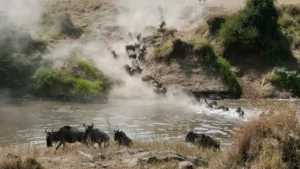
Even in peak season, river crossings are rare and brief. Herds may gather for hours or days, testing entry points and responding to subtle environmental cues. Wind direction, predator presence, or vehicle pressure can stop a crossing instantly. When it finally happens, it may be over in minutes. Guides know that spending only one or two nights near a river is more of a hope than a strategy. They also know that waiting—sometimes all day—is part of the experience. Those who accept waiting often get rewarded; those who chase movement usually miss it.
How Guides Read Behavior Instead of Radio Calls
Inexperienced guides rely heavily on radio chatter. Experienced migration guides rely on observation. They watch herd density, listen for alarm calls, track crocodile positioning, and observe how animals approach water. Tight compression, repeated retreats, and directional consistency all signal intent. Guides position early and wait, sometimes in silence, knowing that leaving too soon is the most common mistake. This skill cannot be marketed easily, which is why many agencies never mention it, but it is often the difference between witnessing a crossing and hearing about it later.
Crowds Disrupt Migration More Than People Realize
Vehicle congestion is one of the biggest threats to natural migration behavior. At famous crossing points, noise, movement, and pressure from dozens of vehicles can delay or divert herds. Guides know that quieter, lesser-known areas often deliver more authentic and successful encounters. Some of the best crossings happen far from the crowds, but only guides who understand broader movement patterns know where to wait. Avoiding crowds is not about exclusivity; it is about respecting how animals make decisions. Being inside the reserve reduces long driving distances, allows guides to reach key areas early, and enables full use of park hours. More time in productive zones and less time on the road dramatically increases the chances of being in the right place when critical migration moments unfold.
Luxury Does Not Equal Better Migration Viewing
Some of the most luxurious lodges are poorly positioned for migration viewing. Long daily drives reduce time in productive areas and increase the chances of missing brief events. Experienced guides favor mobile and seasonal camps that follow movement patterns rather than permanent structures built for views. Comfort matters, but proximity matters more. In migration safaris, flexibility consistently outperforms fixed luxury.
Why Honest Guides Refuse to Guarantee Sightings
Experienced guides do not promise river crossings. They explain probability, uncertainty, and strategy. They prepare guests for days of buildup and moments of intensity. The migration rewards patience, curiosity, and trust in the process. A ten-second crossing after two days of waiting often becomes the most powerful memory of the entire journey. Guides know this, even if agencies find it hard to sell.
Conclusion
What experienced safari guides know about the wildebeest migration is simple but rarely stated: it is not about ticking off a river crossing. It is about understanding movement, reading landscapes, and respecting uncertainty. When travelers stop chasing guarantees and start embracing patterns, the migration reveals itself in deeper, more meaningful ways. That understanding turns a Masai Mara safari into something far richer than a photograph—it becomes a true connection to one of nature’s greatest systems.